




Rope constructions – materials
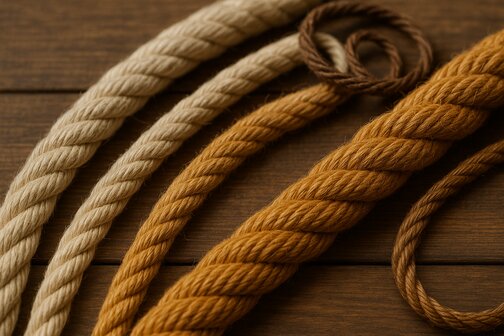
Natural fibers
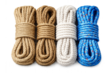
Cotton: It is obtained from the bolls of the cotton plant of the genus Gossypium. It is white in color. Pleasant to the touch, but relatively low in strength.
Coconut fiber: It is obtained from the fibers that protect the nut of the palm tree.
Natural fibres
Cotton: Obtained from the bolls of the cotton plant of the genus Gossypium. It is white in colour. Pleasant to the touch, but relatively low in strength.
Coconut fibre: Obtained from the fibres that protect the nut of the palm Cocos nucifera. The colour is dark brown. A rope made from this fibre will float on the surface until it absorbs water.
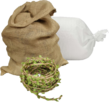
Jute: Fibres are obtained from the bast of the plants Corchorus capsularis or olitorius, from which braided ropes of smaller diameters or gardening twine are made.
Linen: Fibres obtained from the bast of the plant Linum usitatissimum are used mainly in the textile industry. Most traditional canvas fabrics are made from a blend of cotton and linen. Today it is used for ropes with a hemp-like appearance and for common household cords of smaller diameters.
Hemp: Fibres are obtained from the bast of the plant Cannabis sativa, from which almost all ropes and cords were made up until about a hundred years ago. The material is light beige and has good properties.
Sisal: Material from the leaf fibres of the cactus-like plant Agave sisalana is light golden in colour and is used for common ropes and cords.
Manila: These are fibres from the leaves of the Abaca plant (wild banana). The material is straw-coloured and is used to make common ropes, which have largely replaced hemp rope. The quality of manila ropes varies greatly today—from excellent, smooth ropes with regular fibres to rough ropes with fibres of different thickness. With such ropes, be careful when working: you may get a splinter.
Synthetic fibres
Polyamide (PA, nylon): Developed in the 1930s by DuPont. The material is white, elastic, very strong and smooth. It hardens with age. Nylon ropes need protection against UV radiation and partially lose strength when wet.
Use: mooring lines, safety lines, etc.
Polyester (PES/PET, Dacron, Terylene, Vectran): White fibres that retain their strength when wet and are not as elastic as nylon—especially if pre-tensioned. Very durable.
Use: halyards, ropes exposed to static loads and control lines for sails, general-purpose.
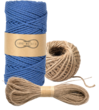
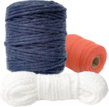
Polypropylene (PP, Hardy Hemp – Marstron): Used to produce inexpensive ropes and ropes with the look of natural materials. The blue variant is made from twisted strips of material. The rope floats and can have a vivid colour.
Use: water-ski ropes and rescue lines
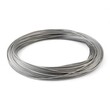
Polyethylene (PE): Ropes made from this coarse material can be white or coloured. They also float. The development of polyethylene led to ultra-high-molecular-weight polyethylene (HMPE), which at the same thickness has the same strength as a steel wire rope. Low weight, water resistance and low stretch make it a popular material for ropes on small sailing boats and racing yachts. However, be very careful, because when knots are tied, HMPE ropes lose a substantial part of their working load capacity!
Polybenzoxazole (PBO, Zylon): PBO has extremely high tensile strength and can be used for standing rigging. As with HMPE, this material also loses a substantial part of its working load capacity when tied into a knot, so it must be terminated either with swaged end fittings or in thimbles.


Add reply to comment: